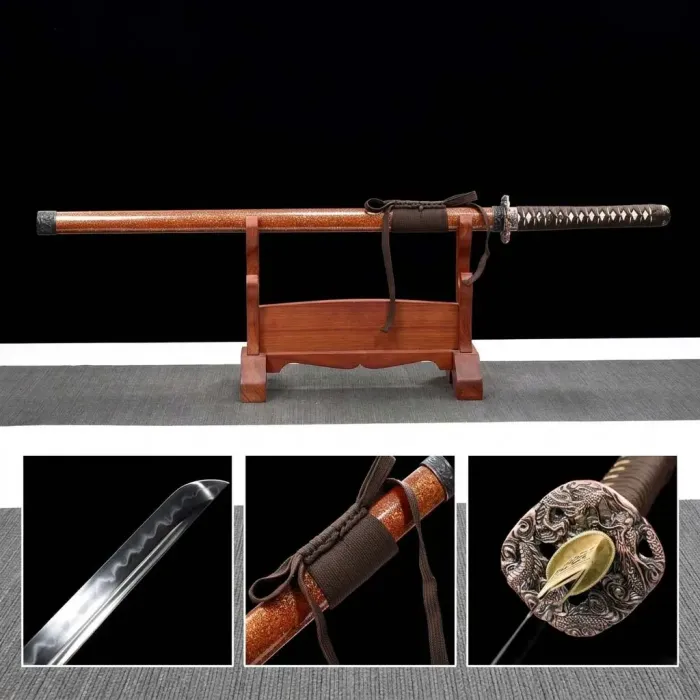
That age-old ancient blade remains a remarkable piece of craftsmanship, but assume you seek to express your separate style? Personalizing your weapon is a significant journey, allowing you to craft a truly singular piece. From the tsuka wrapping and clasp to the plate design and cutting motif, each segment offers a chance for bespoke design. This investigation delves into the sphere of katana modifications, providing guidance for both learners and seasoned enthusiasts searching to form their footprint on the classical art of the samurai.
Newcomer's Original Fabrication
For people excited to embark on the advantageous journey of classical sword techniques , 1060 steel katanas bring an superb entry point. This defined grade of essential steel strikes a nice compromise between economical cost and performance . While never as hard as upper-echelon steels, 1060 grants a adequate level of edge development , making it ideal for starters to cultivate the groundwork of katana upkeep and admire the appeal of artisanal Japanese weaponry. It’s a first-rate choice for cultivating experience without the financial burden of more sophisticated steels.
10# Steel Blades : Achieving Capability and Economy
Enabling fans seeking an authentic weapon experience without overpowering the cash reserve , T10 substance katanas represent a beneficial option. These instruments offer a distinct improvement in strength compared to substandard alternatives, exhibiting respectable edge retention and ample flexibility for simple cleaving techniques. While not rivaling the premium characteristics of top-tier steels like T100 or folded metal , T10 provides a remarkable blend of power and profitability, making them a appreciated choice for rookies and those on a small earnings .
Transcending the Edge : Enhancing Your Weapon's Ornaments and Handle
Although the refined blade is undeniably the primary point of a katana, truly enriching its elegance lies in the cautious customization of its hardware and hold. This technique allows users to showcase their special manner . Explore the sweeping possibilities: menuki - decorative ornaments that enhance visual charm ; the hamon encasements – often artistically sculpted ; the tsuka body itself, wrapped in conventional ito yarn; and the fusa pommel , which can be fabricated from various substances like treasures or ivory .
- Select designs that connect with you.
- Assess with varying composites .
- Focus on robustness for a long-term result .
The Fascination of the Katana: Origins, Mastery, and Material
Each nihonto features a special allure, steeped in periods of Pacific Rim history and heritage . More than merely a artificial item of warfare , it's a icon of the champion ethos – a fusion of artistry and governance . Its expansion spanned numerous generations, with early cutting instruments evolving into the sleek-lined curvature and lethal edge we identify today. The manufacture involved is truly spectacular, requiring lifetimes of education to achieve . The process involves a complex folding of forged iron , creating layers that reinforce the instrument’s flexibility and slicing ability. Diverse schools of fabricating developed , each with their individual secrets and methods for achieving the flawless steadiness and keenness - a truly strenuous pursuit.
- Original Katana styles
- The task of the Japanese sword in bushi culture
- Old-fashioned blacksmithing systems
Determining the Right Steel for Your Weapon Project: 1060 vs. T10
Choosing the correct steel is critically important for any sword project, and the choice between 1060 and T10 can be complex. 1060 is a common American element, offering a acceptable balance of robustness and fortitude, providing it somewhat easy to handle. However, T10, a East Asian steel, frequently boasts improved wear durability and can probably achieve a greater decisive hardness, although it can be substantially laborious to control and requires thorough heat annealing. Consider your proficiency and projected results: for a beginner, 1060 may be a prudent inception, while the competent smith might value the supplementary qualities of T10.
- Ease of Utilizing
- Resistance
- Peak Strength
Achieving Mastery: Complex Katana Adjustment Techniques
Mastering the art of katana improvement extends far beyond basic grinding. Serious experts are now delving into advanced techniques to truly unlock a blade's hidden potential. This demands intricate work with the temper design, utilizing specialized substances for differential hardening and carefully electing the shape of the crossguard to optimize balance and capability. Beyond purely functional alterations, artisans are increasingly focused on generating unparalleled aesthetic charm, through complex etching and layered films that truly transform a katana into a creation.
Building a 1060 Sword from Basic Metal to Beauty
The journey sword custom commences with plain 1060 alloy , a robust material far separated the refined katana it will turn into . Skilled bladesmiths practice a complex process of integrating and shaping the initial steel, repeatedly glowing it and striking it to purify impurities and produce a balanced grain structure. This tedious process, often spanning for days , builds the crucial hardness and pliability characteristic of a bona fide Japanese tool. Subsequent heat adjustments , including precise hardening and quenching , are fundamental to achieve the desired harmony of sharpness, persistence and magnificence.- Layering: Decreases impurities and generates grain structure.
- Forging: Models the steel into the initial blade form.
- Conditioning: Regulates the final hardness and flexibility.
The Durable Charm of the Katana: Intensive Inspection of Steel and Adaptation
A historic katana continues a strong symbol denoting Japanese culture , its fascination far exceeding mere armaments . Forged from rare steel and habitually featuring intricate trims, the process of creation itself is a revered art. Beyond the core craftsmanship, the ability to tailor a katana - from the temper curve to the haft wrapping and fitting - affords for a honestly individual demonstration for both curators and participants alike. This combination of historical steelwork and boundless personalization leads the katana's continued appeal across the world .